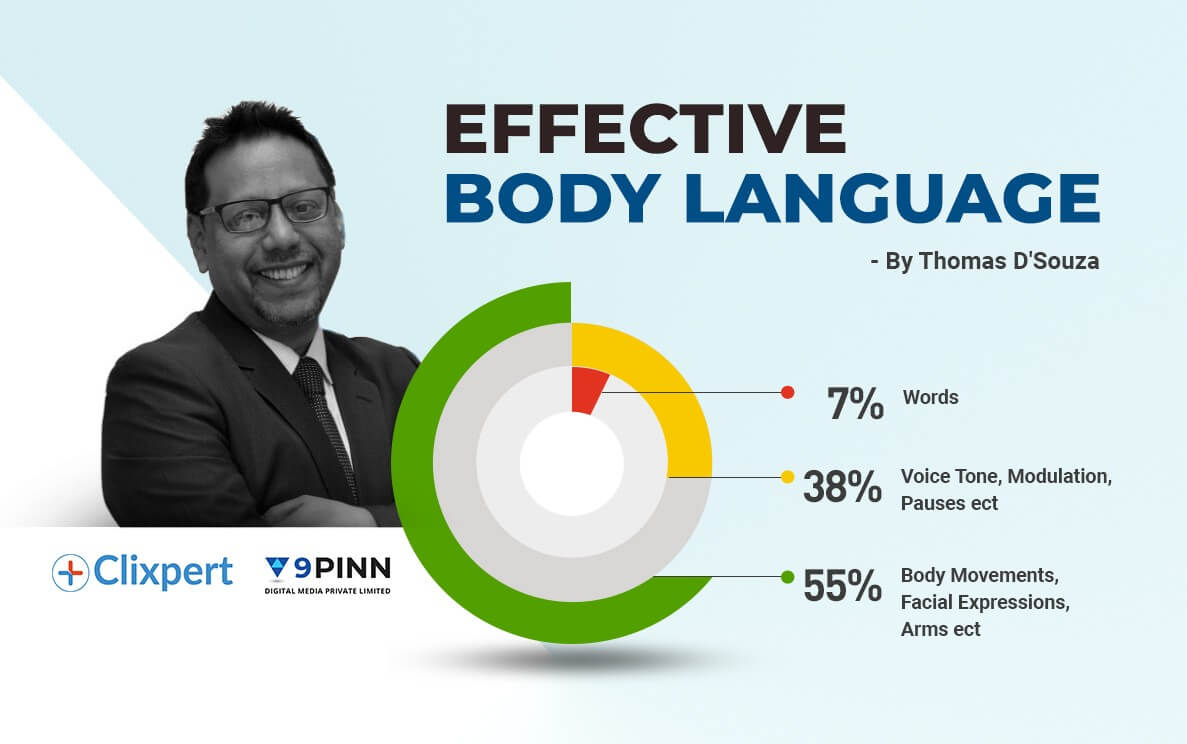
*Did you know that only 7% of a message (speech) is conveyed through words, while 93% comes from non-verbal OR Body Language? The Non-verbal component is made up of 55% BODY LANGUAGE and 38% tone of voice.

So why is that in school, we were never taught the importance of “Body Language” (non-verbal communication), which is key to our development and careers?
*Stats are according to Professor Albert Mehrabian’s research on communication.
Today, I’d like to speak to you on Effective Body Language in 3 parts ie Ineffective Body Language, Effective Body Language and the types of Body Language
What Is Body Language?
Body Language is the unspoken element of communication that we use to reveal our true feelings, emotions, or thoughts.
When conveying a message to an audience, you can either miscommunicate it, or convey it through effective body language
In-effective Body Language
• Adjusting your weight or clothes
• Shifting your glasses
• Arms folded in front of the body
• Minimal or tense facial expression.
• Body turned away from you.
• Eyes downcast, maintaining little contact
• Too much body language (sends the wrong signal)
• Gripping the lectern
• Clutching an object such as a pen or notes
• Fidgeting with clothing or accessories
• Tapping your fingers
• Biting or licking your lips – that’s your nerve talking, not you
TIPS: If gestures do not coordinate with the speaker’s message, it will not mis-align and not convey the message the way you’d like it to be.
I’ll take you back to a media press release by Bill Clinton’s famous words, when he pointed his finger to the camera, while on press, to say
‘to all the American people, for the last time I’m going to tell you that I’ve not had sexual relations with that women”
Now you’ll notice how Bill Clinton points his finger to the camera; a hand gesture that is rude, it conveys arrogance & aggressiveness to the audience, which doesn’t go well while giving a speech or a presentation.
Effective Body Languages
• Use hand gestures
• Have an open posture
• Consider cultural background of your audience
• Use a firm handshake
• Maintain good eye contact
• Avoid touching your face
• Have a positive posture
• Keep your head up
• Note if there are any visually impaired guest in your audience and adjust to them
• Use facial expressions
Whilst there are many types of non-verbal communication or body language, some of the key ones are below.
• Types of non-verbal communication or body language
• Body language is the nonverbal expression of emotions, feelings, and ideas.
• Your posture, movement, position, gestures, eye contact, and facial expressions all contribute to the message you send when you speak.
• Your body language can enhance your communication. or undermine your message.
When you present a speech, effective body language is an essential tool in building credibility and connecting with your listeners. Appropriate gestures focus your audience on you and your message.
Virtual Body Language
Get your camera set up right and position yourself in the centre if possible
Remove distractions in the background
Tidy your workspace or find a quiet area for your video call
Maintain eye contact
Use facial expressions
Avoid background noise and people walking around in the background
Gestures
There are 4 types of effective gestures:
1. Descriptive Gestures: For example, using your hands to show a baby cradle, or an object size, shape, etc.
2. Emphatic Gestures: Showing strong emotions such as intense conviction. For example, placing your hand on your heart in many cultures communicates a powerful belief in your message.
3. Suggestive Gestures: Suggestive gestures are symbols of thoughts and emotions like shrugging your shoulders. While an open palm can suggest giving or receiving ideas.
4. Prompting Gestures: Prompting gestures is a good way to get a response from an audience. For example, show your hands to answer a question, or raise your hand to encourage audience to contribute to a feedback.
Here are some tips on body language
• When you get nervous, you try to cover your vital organs, that’s why a lot of speakers fold their hands, bring it front of them, which is a sign of nervousness.
• Great speakers keep their body open, so there’s no barriers between the speaker and the audience.
• While starting out a speech, keep your body open in posture so that you engage with your audience.
• Have your palms open. When you look at the inside of your palm, your eyes feel relaxed. Never show the back of your palm to the audience.
• Get comfortable with the stage by moving around till you find the right spot to deliver your message.
• Never turn your back to the audience.
Summary
• Using body language (non-verbal communication) is key to a great presentation or speech.
• Using effective gestures can convey your message effectively with an engaged audience.
• Make sure you have your palms opened (face up) to maximise openness, truth, and honesty.
• Avoid palm down position, or it will convey the wrong signal you don’t want, as it shows assertiveness and dominance.
• Remember not to do a ‘Bill Clinton’ pointing your finger to the audience. It may inadvertently invoke negative feelings into your audience, in an aggressive or angry manner. It may be seen as a verbal confrontation to the accuser who’s making a strong personal attack against someone.
• Avoid negative or in-effective body language to deliver a great presentation or speech.
• Effective body language can be used in your everyday life and not just in your careers, to communicate effectively.
• Lastly, practice, practice, practice, and you will make a far more effective presentation or speech.
I am Thomas D’Souza – Head of Digital Solutions & Business Growth at Clixpert Digital Media Group (Australia) & 9Pinn Digital (Bangalore). I enjoy playing the piano/keyboards and singing in my spare time or go fishing with my mates. What inspires me the most is philanthropist who contribute their time, energy, and effort without any financial gain. I’m passionate about business, digital marketing and helping my clients grow their brands through digital strategies.